Greetings & Acknowledgements
General greetings
Two greetings posters have bright child-friendly borders by Gamilaraay artist Talieah Donnelly.
Traditionally Yaama was a question word (to create Yes-No questions), and in modern times it is also used as a greeting.
Download the pdf of this poster here: Yaama_Jan2023.pdf
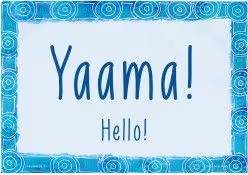
The meaning of Yaluu is 'again', and in modern times this is used as a farewell.
Download the pdf of this poster here: Yaluu.pdf

Our greetings poster has pictures by Gamilaraay student Cheyenne Aldridge and handprints from Winanga-li Early Learning Centre children. It can be printed in A3.
Download it here: Yaama_05AUG2022.pdf

Our greetings song has vocals by Gamilaraay singer Loren Ryan and with photos of Winanga-li Early Learning Centre children and staff.
- It includes some respectful ways to greet adults, i.e. walgan (aunty), garruu (uncle), as well as maliyaa (friends).
- It also has the different pronouns used in greetings and answers according to the number of people, i.e. nginda (you -one person), ngindaali (you - two people), ngindaay (you - three or more), ngaya (I), ngali (we - two people), ngiyani (we - three or more).
Download the songsheet here: Yaama-maliyaa_21FEB22.pdf
Gaba nginda? Gaba ngaya.

Download a pdf of the poster: Gaba-nginda-Gaba-ngaya.pdf
Here is a video from the staff and children at Winanga-li:
Gaba ngindaay? Gaba ngiyani.

Download a pdf here: Gaba-ngindaay-Gaba-ngiyani.pdf
Download a pdf without photo :Gaba-ngindaay-Gaba-ngiyani_blank.pdf
Ngaandi ngaya? (Who am I?)
The grammar here is a bit different from English. Ngaya (I) is used instead of ngay (my) in certain situations where something is regarded as being part of the whole, e.g. name/person, body part/person, person/family land, and ngaandi (who) is used instead of minya (what).
Here are four name labels, with designs by Sharon (Dawnie) Wortley:
Download the pdf here: Name-labels.pdf

We have three worksheets which can be used as 'getting to know you' activities at different levels. The first two include versions with QR codes for educators or caregivers who would like pronunciation support.
The first worksheet is for young children to draw themselves and/or add collage items as a craft activity.
Download the pdfs here: Ngaandi-nginda-gayrr_20JAN24.pdf, Ngaandi-nginda-gayrr_QR-codes_20JAN24.pdf


The second worksheet is for older children. The version with QR codes is with sound files of traditional words - gagan (colour) and maabu (number) are newly developed words.
Download the pdfs here: Ngaandi-ngaya_13JAN23.pdf, Ngaandi-ngaya_QR-codes_20JAN24.pdf


This third worksheet is more advanced. It starts with a quote to show the importance of these phrases. It refers to people who have passed away, so please use as appropriate.
The worksheet uses verb tense suffixes, as well as the different forms of the place suffix -Dhi.
Download the pdf here: Who-am-I_08AUG22.pdf

Gulbiyaay (welcome)
Welcome to our school - Gulbiyaay dhirrabaa-ga ngiyaningu!
Welcome to our room - Gulbiyaay ngana-ga ngiyaningu!
Download the posters here: Gulbiyaay-posters.pdf
Welcome to country or Acknowledgement of country
Our children's acknowledgement is with our Dhawun (Country) materials
An acknowledgement or welcome would usually start with a general greeting, and could include your name and country.
For the main body of the welcome or acknowledgement, here are some Gamilaraay options to mix and match according to the situation:
- Basic version
Words: Acknowledgement_Basic_21SEPT22.pdf
Sound (by Gindjurra): Download
- Acknowledging Baiame
Words: Acknowledgement_Baayaami_21SEPT22.pdf
- Acknowledging Elders
Words: Acknowledgement_Elders-past-present-future_21SEPT22.pdf
Sound (by Gindjurra): Download
- Acknowledging land, sovereignty
Words: Acknowledgement_land-21SEPT22.pdf
A more detailed discussion, including Yuwaalaraay options, is here: 2021-05-compilation_welcome_acknowledgement.docx
Here is an example of a beautiful acknowledgement by proud young Ngemba man Keaton Walters in 2020 (basic version):